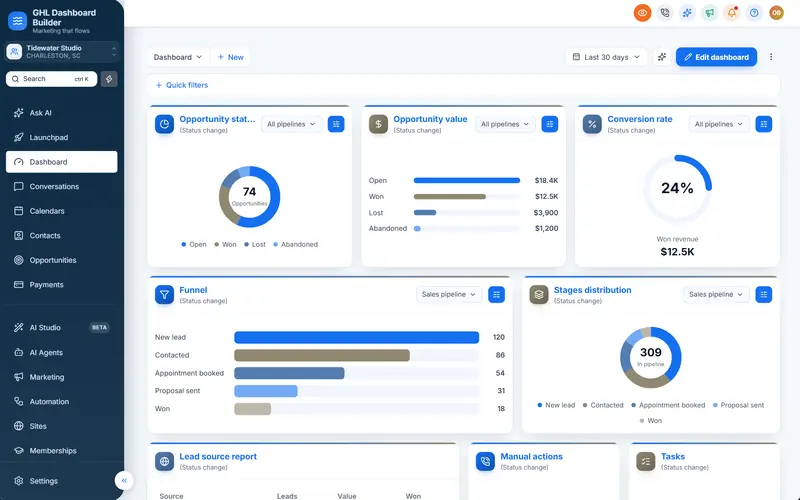
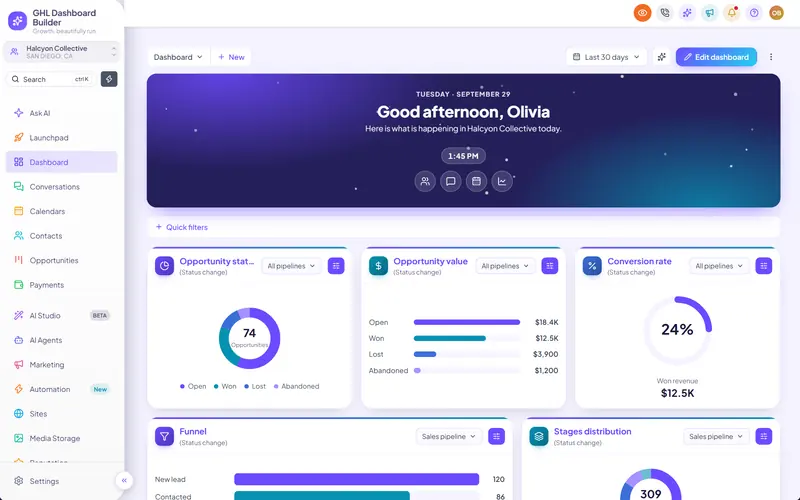
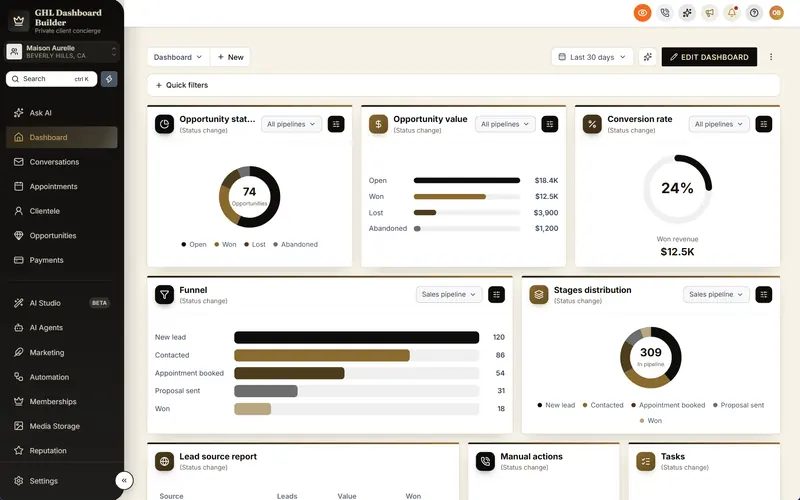
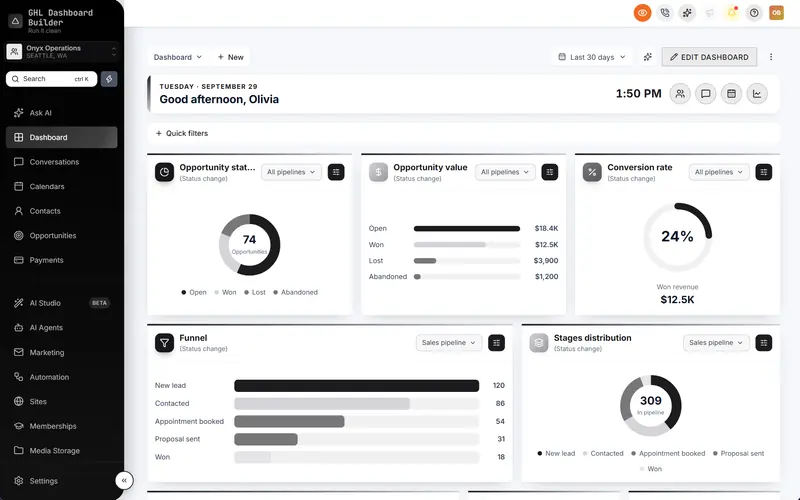
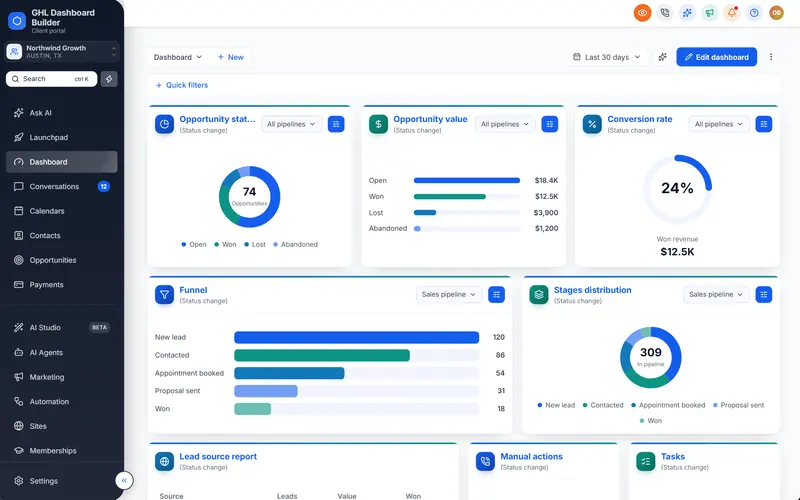
A property management company near King Fahd Road signs up for the platform you sell. Their leasing team works in Arabic, their new investor relations manager came from a regional headquarters and writes everything in English, and their compliance officer wants to know how the system handles the rent freeze and Ejar contracts. They also want the dashboard to look like their company, not like a tool every agency in Olaya resells. HighLevel can do all of that, but not with the default screens and not with a setup copied from a client in Jeddah or Dubai.
This guide is for agencies that sell HighLevel (also called GoHighLevel or GHL) to businesses in Riyadh. It is narrower than our guide to white-labeling HighLevel in Saudi Arabia, which covers Arabic-Indic digits, Hijri dates, VAT, e-invoicing and SMS sender rules across the Kingdom. Here we focus on what is specific to the capital: its size and business mix, the rent freeze, real estate license rules, the regional headquarters wave, Riyadh Season, and how the dashboard should look for each kind of client. It ends with a step-by-step setup. GHL Dashboard Builder is an independent design service and is not affiliated with HighLevel; where our product helps, we say what it does and where it stops.
What makes HighLevel white label in Riyadh different?
Riyadh concentrates more of Saudi Arabia’s businesses, headquarters and regulators than any other city, so a Riyadh client list is both larger and more mixed than elsewhere in the Kingdom. The national basics still apply, but on top of them you meet capital-only rules such as the rent freeze, and a split between Arabic-first local firms and English-first international ones.
Start with the size. The Riyadh region had 8,591,748 residents in 2022, according to the DataSaudi profile of the Al Riyadh region, which makes it the most populous region in the Kingdom. Most of those people live and work in the city itself, and the capital’s growth is the reason so many agencies open an office there or fly in for meetings.
Then the businesses. Monsha’at, the Saudi authority for small and medium enterprises, reported about 1.3 million SMEs in the Kingdom at the end of 2023, with 43.7 percent of them in the Riyadh region, as its Q4 2023 SME Monitor release and Arab News’s report on it state. Clinics, brokerages, restaurants, training centers and contractors make up much of that base, and they are the clients who buy HighLevel from agencies.
Infographic
Riyadh for HighLevel agenciesby the numbers
8.59M
residents of the Riyadh region in 2022
(DataSaudi)
43.7%
of Saudi SMEs were in the Riyadh region at the end of 2023
(Monsha'at SME Monitor, Q4 2023)
5 years
rent freeze inside Riyadh's urban boundary from 25 September 2025
(Gulf News)
176 km
Riyadh Metro network across six lines, fully open since January 2025
(Arab News)
Sources: DataSaudi; Monsha'at SME Monitor Q4 2023; Gulf News (September 2025); Arab News (January 2025).

The third layer is regulation that lives in Riyadh. The Real Estate General Authority (REGA), the Saudi Data and AI Authority (SDAIA), the Ministry of Investment and most procurement bodies sit in the capital, and some rules, like the rent freeze, apply only inside the city’s urban boundary. That matters for HighLevel because rules become custom fields, pipeline stages, workflow conditions and message templates in your clients’ sub-accounts. A sub-account is one client’s workspace in HighLevel; HighLevel also calls it a location.
The identity layer comes first everywhere: your logo, a custom login domain and legal links under Settings, Company, Whitelabel. If that is not done yet, our guide on how to white-label HighLevel walks through it. This article assumes it is in place and covers what a Riyadh client notices next.
Who buys HighLevel from agencies in Riyadh?
Five client types make up most Riyadh agency books: property brokerages and managers, regional headquarters and professional firms, clinics, hospitality and entertainment businesses, and training and education providers. Each one needs a different language choice, different wording in the menu and different rules in its automations.
| Riyadh client type | What shapes the setup | What it changes in HighLevel |
|---|---|---|
| Brokerage or property manager | REGA licenses, Ejar registration, the five-year rent freeze | License and contract fields on listings, a leasing pipeline without rent-increase stages |
| Regional headquarters or professional firm | Group brand rules, English-first teams, PDPL questions | An English design in the group’s colors, written answers on what the code does |
| Clinic, dental or aesthetic practice | Arabic-first front desks, sensitive patient data | Patients in the menu, careful demos, little health detail in HighLevel |
| Restaurant, hotel or entertainment venue | Riyadh Season from October to March, event peaks | Seasonal pipelines and campaigns, Reservations or Bookings in the menu |
| Training center or education provider | Saudi students and parents, intake calendars | Courses and Students in the menu, Arabic messages, term-based follow-ups |
Two patterns run through the table. First, language is a per-client decision in Riyadh, not a city-wide one: a Saudi-owned clinic and a multinational’s regional office can sit in the same tower and want opposite things. Second, the strongest Riyadh-specific requirements come from property, because the rent freeze and licensing rules touch almost every brokerage and property manager in the city.
How does GHL Dashboard Builder handle a Riyadh setup?
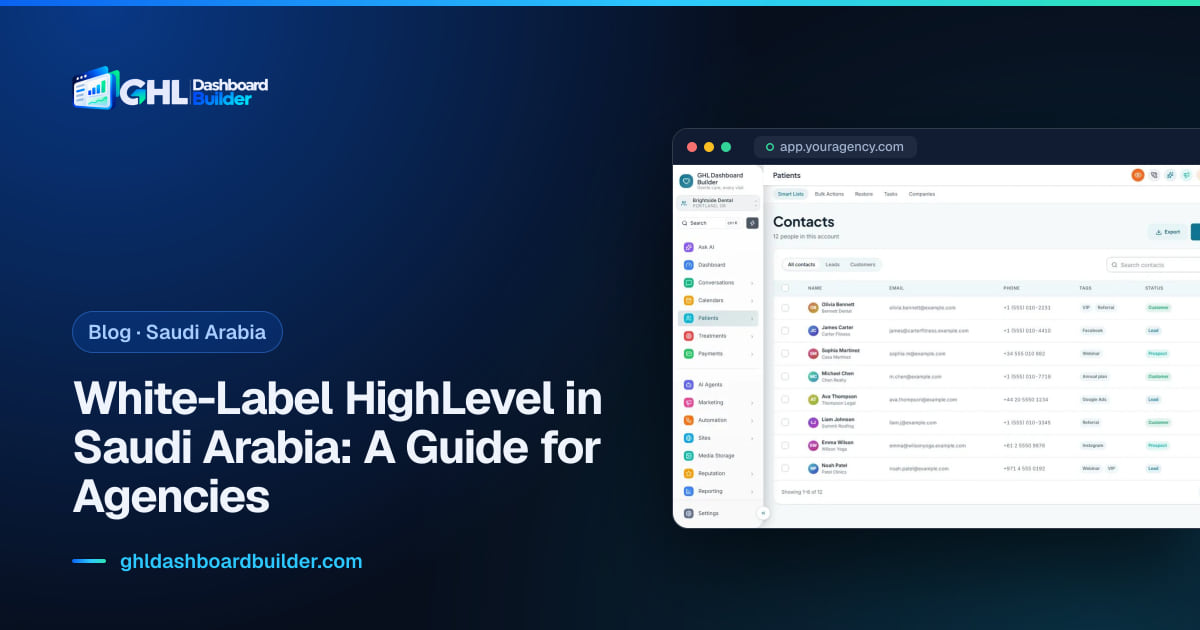
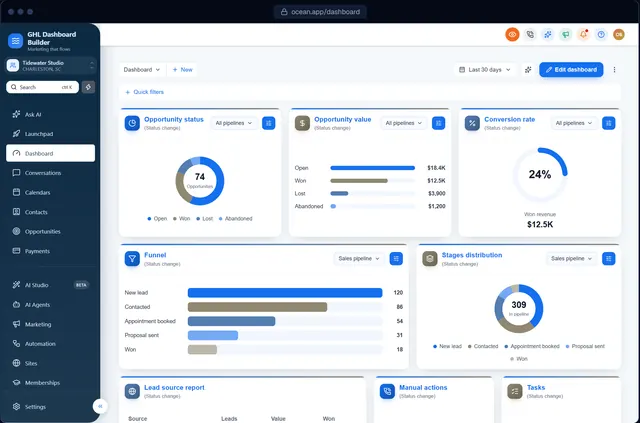
GHL Dashboard Builder is an independent design service that turns the standard HighLevel (GoHighLevel) dashboard into a branded platform: your colors, menu, login design, privacy mode and your clients’ language, installed with two lines of code. For Riyadh agencies the useful parts are the Arabic right-to-left menu, menu renames, sector templates, a branded pipeline board, privacy mode and designs limited to chosen sub-accounts.
We design the look in our builder and install it for you as part of a one-time $100 setup fee: one CSS line and one JavaScript line in Settings, Company, Whitelabel, Custom Code, which takes about 5 minutes. After that, every client who opens HighLevel in a browser sees the design. The builder never connects to your HighLevel account, and the installed code does not send data anywhere, which keeps the conversation with a client’s compliance team short.
| Feature | What it does for your Riyadh clients | Plan |
|---|---|---|
| Languages and right-to-left | HighLevel’s menu and navigation in Arabic, mirrored right to left, among 15 languages | Pro and Agency |
| Noor templates | Ready-made Arabic dashboards on an emerald and gold look, right to left (Noor) or left to right (Noor LTR) | Pro and Agency |
| Menu editor | Rename, reorder and hide any of HighLevel’s 19 menu items: Listings, Patients, Courses | Pro and Agency |
| Templates | 27 templates, including Executive, Estate and Clinic, recolored to the client’s brand | All plans |
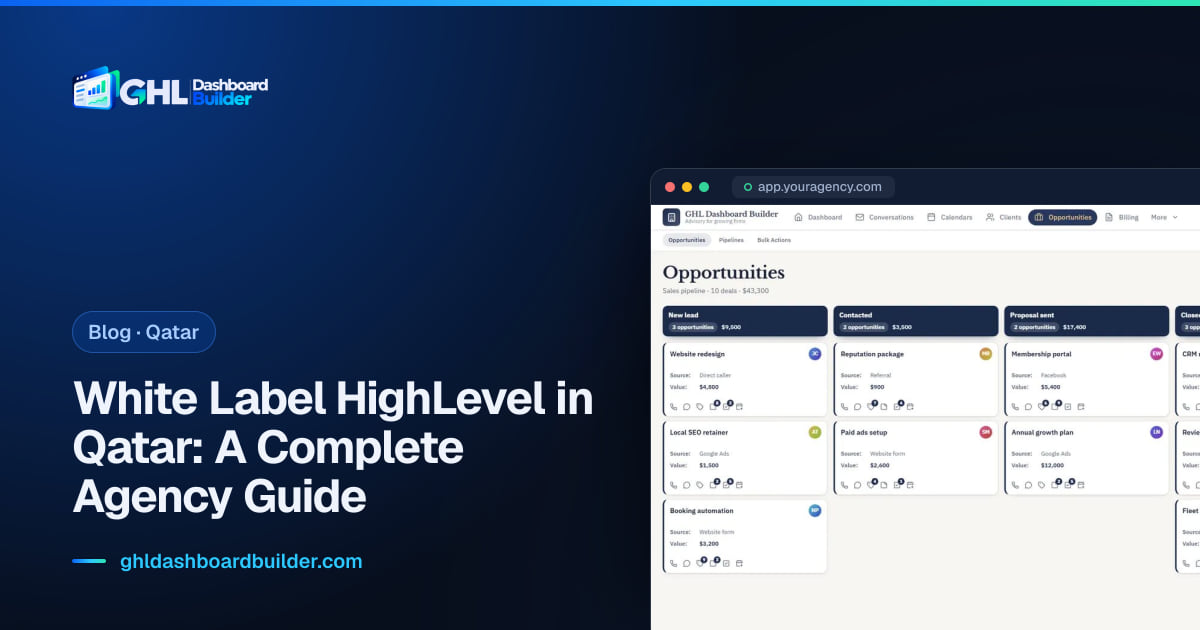
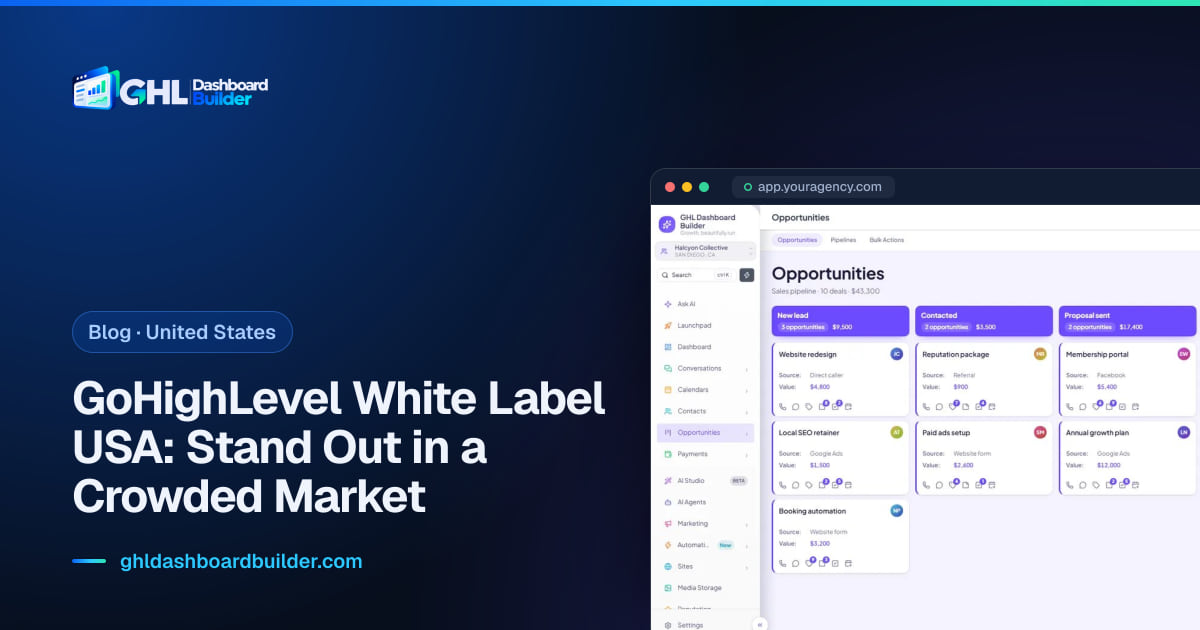
| Opportunities board | Branded stage headers and opportunity cards on the pipeline board | All plans |
| Privacy mode | An eye button that blurs names, emails, phone numbers, conversations and deal values | All plans |
| Only these sub-accounts | A design shown only in the sub-accounts you choose, from one install | All plans |
| Login page design | 25 login designs on your white-label sign-in page, in your colors | Pro and Agency |
Each of these features comes back in the sections below, where it solves a specific Riyadh problem. The full list, including what is preview only, is on the features page. If you mainly want the identity side covered, our GoHighLevel white label dashboard page explains how the theme and HighLevel’s own white-label settings work together.
Which language should a Riyadh client’s HighLevel use?
Arabic first for Saudi-owned businesses and front-line teams, English for most regional headquarters and international firms, and both where a team is mixed. Decide per client by asking who logs in every day, because in Riyadh the answer changes from one office to the next.
Our own market notes for Saudi Arabia say that business teams expect Arabic-first software. In Riyadh that holds for most clinics, brokerages, contractors and training centers, where receptionists, leasing agents and coordinators spend the day in conversations and calendars. A menu in English forces them to translate every label in their heads, and they notice it every morning.
The regional headquarters wave adds the opposite case. A finance team that moved from Dubai or London to a Riyadh office often works in English, follows a group brand guide and reports to managers outside the Kingdom. For them, a clear English menu in the group’s colors is more useful than Arabic. Saudi colleagues in the same office may still prefer Arabic, which is a reason to give individual users a choice rather than forcing one language on everyone.
What HighLevel offers natively
HighLevel has begun translating its interface. HighLevel’s help center article on internationalization explains that a sub-account’s default language is set under Settings, Business Profile, Platform Language, and each user can change their own under Settings, My Profile. At the time of writing the list is mostly European languages, and on HighLevel’s public ideas board the request for Arabic language support is marked as under review. Check both pages before you promise a Riyadh client anything, because HighLevel ships changes often.
What a theme adds
A theme fills the gap for the menu and navigation. GHL Dashboard Builder translates HighLevel’s menu and navigation into Arabic, switches the layout to right to left and moves the sidebar to the right, with your own wording for any label. The Noor templates start from a finished Arabic design; Noor LTR keeps the familiar left-to-right layout for teams who want Arabic words without flipping the screen.
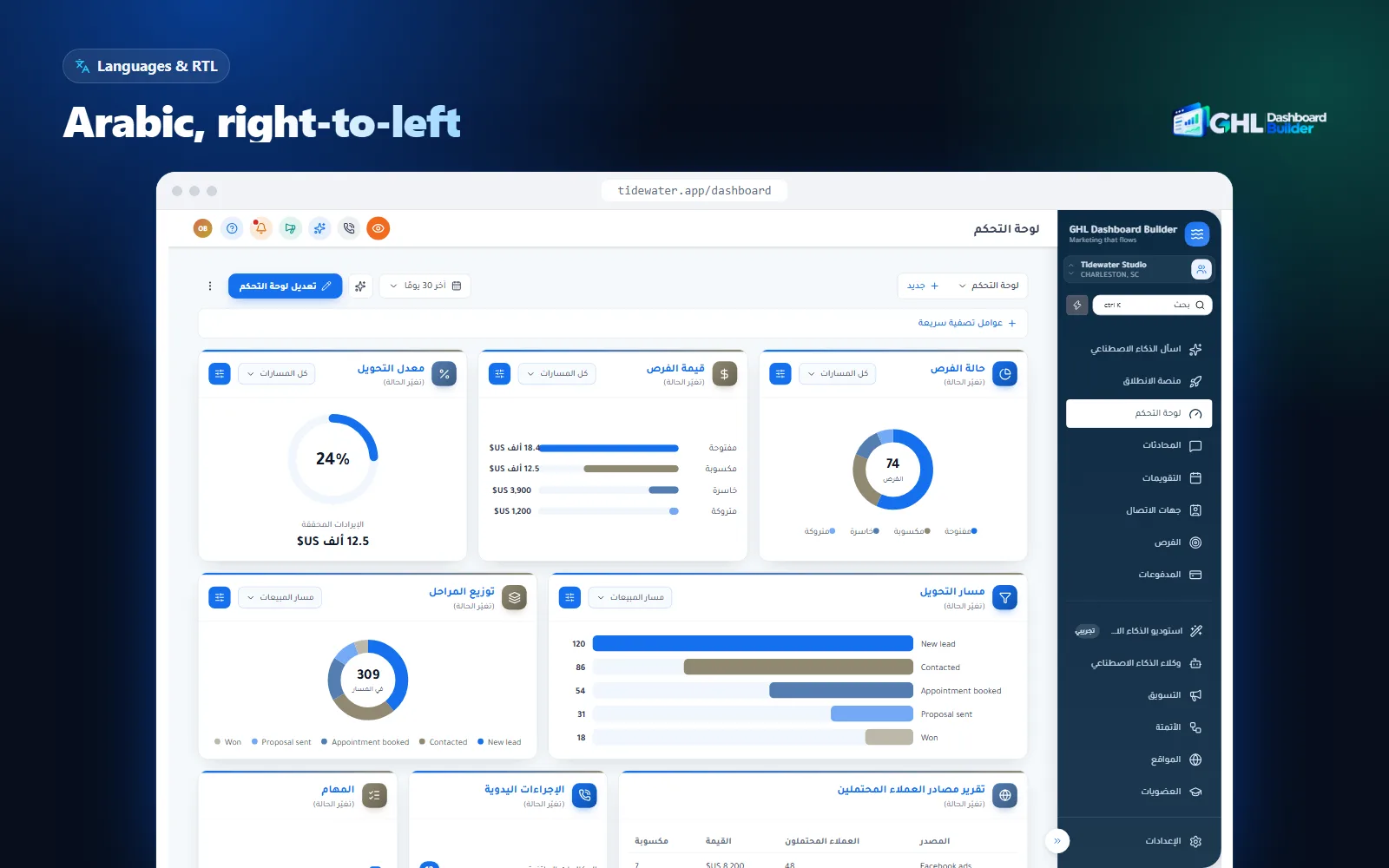
Two honest limits apply. Text inside HighLevel’s own pages, builders, system emails and the mobile app follows HighLevel’s language settings, so a theme does not translate the whole platform. And a theme does not write your clients’ content: Arabic forms, funnels and message templates are still written by people who speak the language. Our guide to giving clients an Arabic HighLevel dashboard goes deeper into what mirrors well and what to test.
How should a Riyadh brokerage set up HighLevel under the rent freeze?
Build the leasing side around registered contracts and service, not rent increases, and give every listing fields for the license numbers Saudi rules require. Riyadh’s property clients face two sets of rules at once: the national REGA licensing system and a rent freeze that applies only inside the capital’s urban boundary.
What the rent freeze changes
Since 25 September 2025, rents for residential and commercial properties inside Riyadh’s urban boundary may not rise for five years, covering existing and new contracts, as Gulf News reported when the rules were announced. Vacant units that were rented before must be let at the value of the last contract registered on Ejar, the government’s lease platform. Leases must be recorded on Ejar, and violations can bring fines of up to 12 months’ rent. King & Spalding’s summary of the regulation also describes automatic lease renewal, which is worth reading with the client’s lawyer.
For a HighLevel setup that means a few concrete changes:
- An Ejar field on every lease. Create custom fields for the Ejar contract number, the registered annual rent and the contract end date, attached to the opportunity. The registered rent is what a vacant unit must be re-let at, so the agent needs it on screen.
- No “rent review” stage. Many leasing pipelines copied from other cities have a stage for negotiating an increase at renewal. In Riyadh, remove it or rename it to a renewal-check stage that confirms registration and tenant details.
- Renewal reminders that sell service. A workflow that reminds tenants before renewal should talk about maintenance, payment options and contract registration, not about new prices.
- A check before a unit is advertised. A condition that stops a listing campaign when the Ejar or license fields are empty, and creates a task for the agent instead.
License numbers on every ad
REGA licenses brokerage work through the FAL system. REGA’s frequently asked questions describe a dedicated real estate advertising license that lets the holder publish ads in print, audio, visual and electronic media, issued against a valid brokerage contract that includes marketing rights. REGA also runs an inquiry service for checking advertisement licenses, which means buyers and tenants can verify what your client publishes.
Add fields for the broker’s FAL license number, the advertising license number and the brokerage contract number, group them in a folder named “Listing compliance,” and pull them into funnel pages, social posts and email templates instead of typing them by hand. HighLevel does not check any of these numbers with REGA; your client’s compliance person still owns that. Our guide to GoHighLevel for real estate covers the wider brokerage setup, from lead sources to viewing reminders.
A board the owner is happy to show
Riyadh brokerages and property managers usually run two pipelines: sales, often with off-plan projects, and leasing and renewals. Name the stages in the client’s words and make the board look like the company’s own system, because owners show it to investors, landlords and partners. The board is where agents spend their day, so it is the screen that most needs the client’s brand.
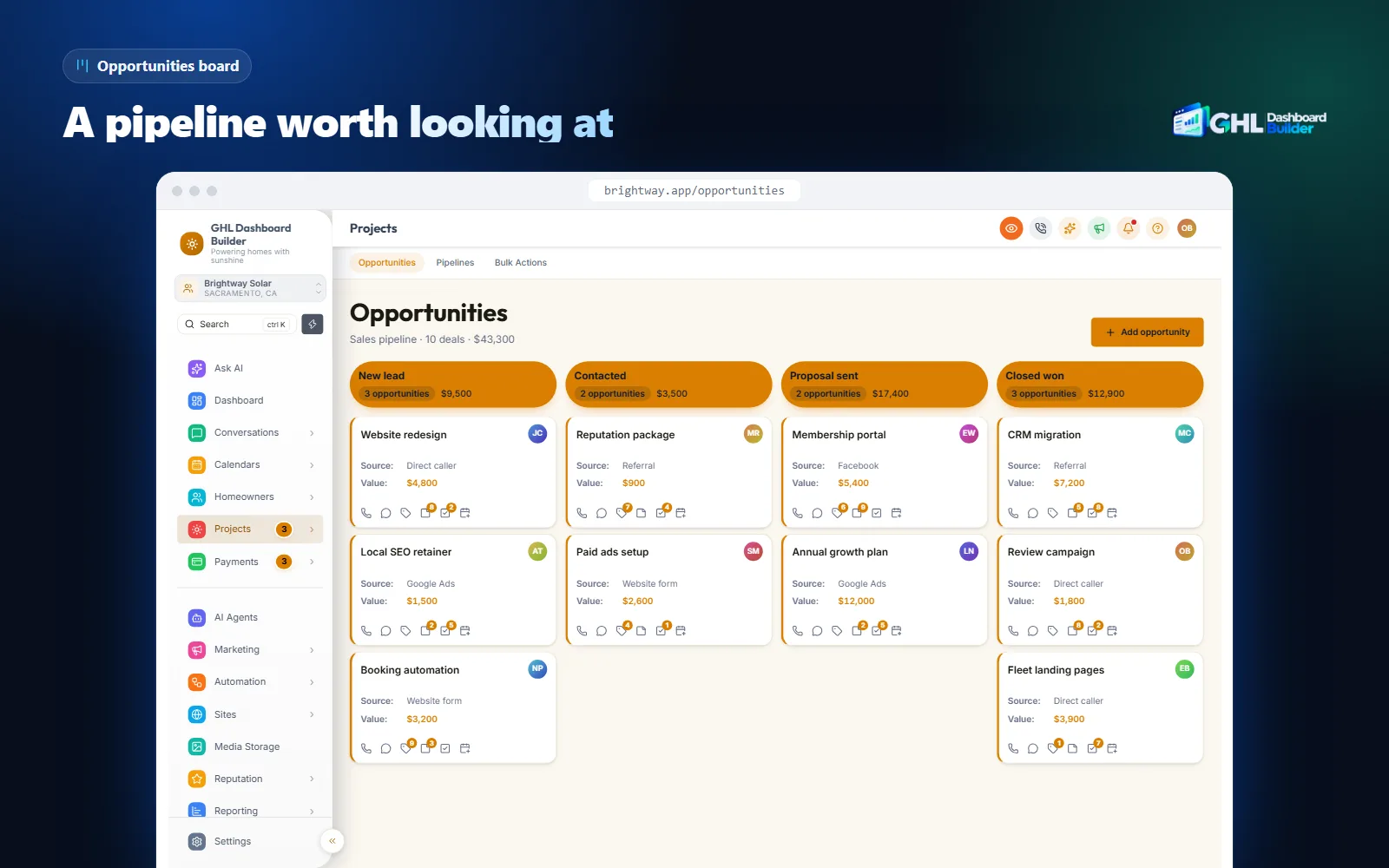
The Estate template is a natural starting point for property clients: warm neutrals, charcoal and brass, top navigation, and Contacts renamed to Clients and Opportunities to Listings. See it on the Estate template page and recolor it to the brokerage’s brand in the builder. Our guide to GoHighLevel pipeline customization explains how to plan stages before you style them.
What do regional headquarters clients in Riyadh expect from a CRM?
They expect software that follows the group’s brand, works in English, and comes with clear answers about data and code. Regional headquarters teams are a growing part of Riyadh’s client base, and they buy differently from local SMEs: more people sign off, brand rules are stricter, and security questions come in writing.
The flow of headquarters into the capital is policy-driven. From 1 January 2024, Saudi government bodies stopped contracting with foreign companies that do not have a regional headquarters in the Kingdom, as The National reported when the rule was announced, with exceptions later set out for small contracts and special cases, as Asharq Al-Awsat explained. The Ministry of Investment keeps issuing licenses: 44 in the first quarter of 2025, as Mubasher reported, 34 in the second, according to Arab News, and 31 in the third, according to Mubasher’s Q3 report.
A fourth-quarter figure was not available when we wrote this. Source: Ministry of Investment Economic and Investment Monitor, as reported by Mubasher (Q1 and Q3 2025) and Arab News (Q2 2025).
Not every regional headquarters is a HighLevel client. The ones that are tend to be the firms around them: the consultancies, training providers, recruitment firms, event companies and clinics that serve headquarters staff, plus smaller international companies that run their regional marketing from Riyadh. All of them compare your platform with enterprise tools they used elsewhere.
What to build for them
- The group’s brand, exactly. Colors, fonts and logo from the brand guide, with no agency colors in sight. The Executive template, navy and muted gold with serif headings and top navigation, is a calm starting point; see the Executive template page.
- Plain English labels. Rename Opportunities to Deals or Engagements and Contacts to Clients or Accounts, in the words the firm already uses in reports.
- A short menu. Hide the modules the team will never open, so a finance or operations user sees five items, not nineteen.
- Written answers on code. A compliance officer will ask what each script in HighLevel’s Custom JavaScript box does. “It restyles the interface and renames menu items, and it does not read or send data” is an answer they can accept.
Saudi Arabia’s Personal Data Protection Law, which SDAIA enforces, became fully enforceable on 14 September 2024, as Clyde & Co explains. Expect international clients to ask where data is stored and which processors touch it. Those are questions about HighLevel and your agency’s processes; a theme only affects how the screens look. This is an overview, not legal advice.
Which design suits Riyadh clinics, restaurants and Riyadh Season businesses?
A calm, clear design for clinics, a warm and seasonal one for hospitality, and in both cases menus named for patients, bookings and guests. These are the clients whose busiest months follow Riyadh’s own calendar, so their automations matter as much as their colors.
Clinics
Private clinics, dental groups and aesthetic centers are a common kind of agency client in Riyadh, and their front desks usually work in Arabic. The Clinic template gives the right base: a white sidebar with medical teal, Contacts renamed to Patients and Opportunities to Treatments. See it on the Clinic template page, and read our guide to HighLevel for dental and medical practices for the wider setup.
Keep clinical detail out of HighLevel unless the clinic and its advisers have decided otherwise. Many clinics keep records in a licensed medical system and use HighLevel for enquiries, bookings and reminders. Under the PDPL, health data is sensitive data, so the less of it sits in a marketing tool, the easier the clinic’s answers become.
Restaurants, hotels and entertainment venues
Riyadh Season sets the rhythm for hospitality. The 2024 edition opened on 12 October 2024 and had passed 18 million visitors by late January 2025, according to Gulf News, citing the General Entertainment Authority. Those figures come from the organizer, but the pattern is clear: restaurants, venues, hotels and tour operators near the season’s zones get their busiest months from autumn to spring.
Further out, Riyadh won the vote to host Expo 2030 with 119 votes, and the event is planned for October 2030 to March 2031, as Al Jazeera reported. For agencies, that is a reason to build hospitality and events accounts that can handle seasonal peaks without being rebuilt every year.
For these clients:
- Seasonal pipelines. A pipeline for group and corporate bookings during the season, with stages for enquiry, quote, deposit and confirmed.
- Reservations in the menu. The Saffron template renames Calendars to Reservations and uses a warm palette; see the Saffron template page.
- Directions in reminders. Since the Riyadh Metro opened in full in January 2025, with six lines over 176 km as Arab News reported when the Orange Line opened, some guests and patients come by train. Add the nearest station to confirmation messages where the client wants it.
- Bilingual guest messages. Guests may write in Arabic or English. That is content: two versions of each template, written by people who speak each language. The dashboard language only decides what staff see.
How do you demo a branded HighLevel to Riyadh clients without exposing data?
Use a demo sub-account where you can, and blur real data where you cannot. Riyadh sales cycles involve many screen-shares: pitches to owners, support calls with front desks, training for new staff and reviews with headquarters managers who join from other countries. Each of them can show names, phone numbers and deal values the client never agreed to share.
The risk is sharper in Riyadh for two reasons. Property and corporate deals carry large values and well-known names, so a screenshot of a pipeline can embarrass a client. And under the PDPL, showing a contact’s details to people who should not see them is a data protection issue as well as a trust problem.
A demo routine that works
- Keep a demo sub-account with realistic but invented contacts, listings and appointments, branded with the design you are pitching, in Arabic and in English.
- When you must show a live account, for support or training, switch on blurring before you share and check the preview window before you speak.
- For recorded training, record on the demo sub-account, or blur and then watch the recording once before you send it.
- Close other tabs and notifications. A WhatsApp preview in the corner of the screen is a common leak.
- Write the rule into onboarding. One line in your onboarding pack about how you handle client data on calls answers a question many Riyadh compliance teams will ask anyway.
GHL Dashboard Builder’s privacy mode is an eye button in HighLevel’s header. One click blurs contact names, email addresses, phone numbers, the conversation list and opportunity values on the screens you share, and you choose how strong the blur is. It is included on every plan.
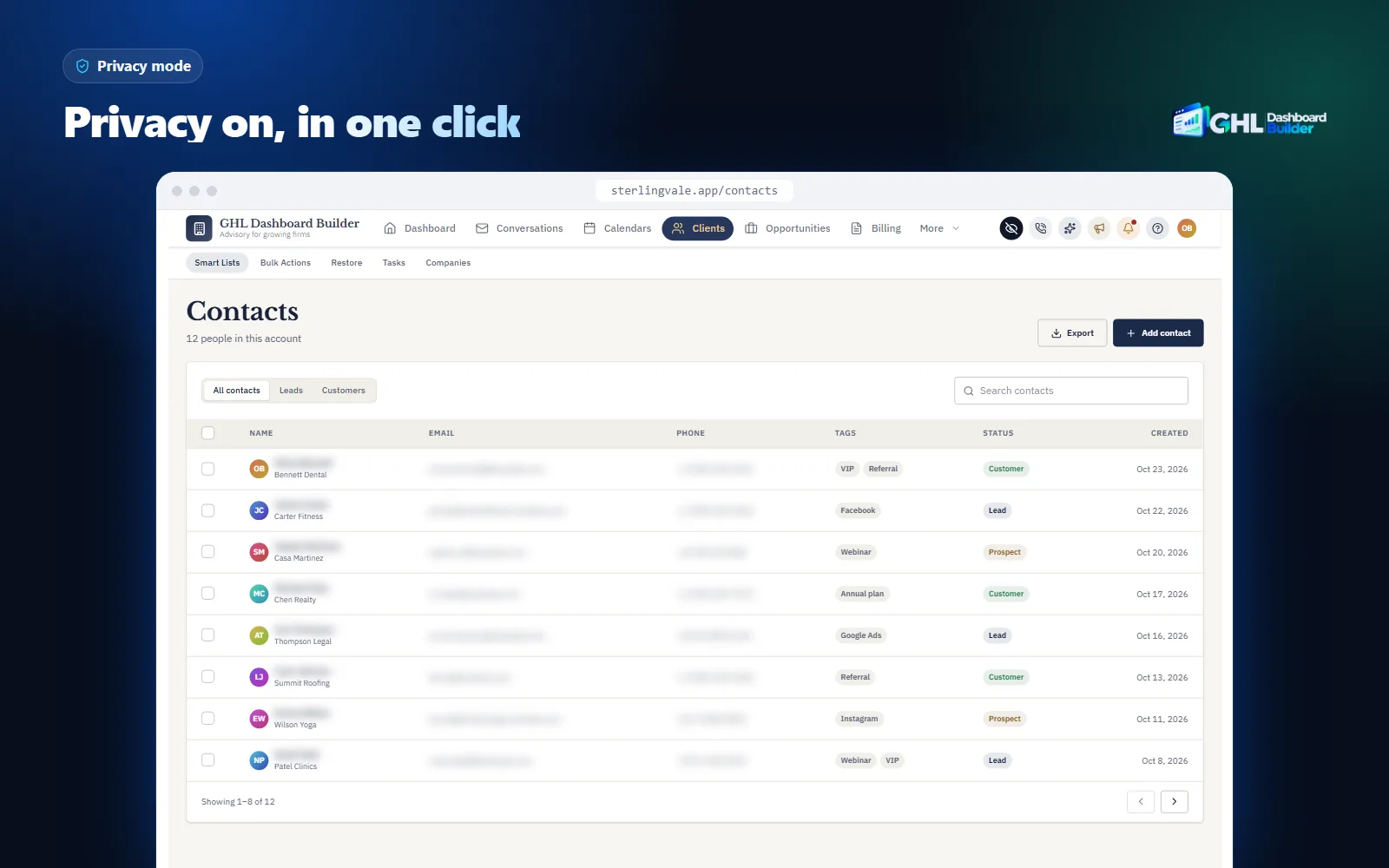
Privacy mode is a presentation tool, not access control. It does not stop a user from seeing data their HighLevel role allows, and it does not replace user permissions. Our guide to hiding client data in GoHighLevel covers user roles, demo accounts and recordings in more detail.
Should every Riyadh client get the same design?
Usually not. A typical Riyadh client list mixes Arabic-first clinics and brokerages with English-first international firms, and premium clients who pay for “their own system.” Give your agency one consistent design and give the clients who need it their own, limited to their sub-accounts.
Reasons to treat some clients differently:
- Language. A clinic’s front desk works in Arabic right to left, while a regional office works in English.
- Brand rules. A multinational client must see its group colors, not your agency’s.
- Sector wording. A property manager needs Listings and Tenants, a clinic needs Patients; one menu cannot say both.
- Pilots. You want to test a right-to-left design on one friendly client before rolling it out.
HighLevel’s Custom CSS and Custom JavaScript boxes sit at agency level, so by default whatever you paste there applies across your sub-accounts. To give one client a different look, the theme itself must know which sub-accounts to target. GHL Dashboard Builder does this with an “Only these sub-accounts” option: you add the client’s sub-account by its link or Location ID, that sub-account shows the design, and every other sub-account and the agency view keep plain HighLevel. You still paste one install code. Details are on the single sub-account page, and our guide to GoHighLevel sub-account branding explains the options.
One install shows one design in the sub-accounts it targets. If you want, for example, an Arabic design for your Saudi clients and an English design for your international ones, Pro gives you up to 3 designs and Agency up to 100; talk to us about how to set them up across clients before you buy.
How do you set up HighLevel for a Riyadh client, step by step?
Prepare the sub-account’s local settings, add the Riyadh-specific fields and rules, build the pipelines, then install and test the theme on that one sub-account. The steps below use a property manager as the example and assume your agency’s identity layer is done and you have agency admin access. Menu paths are as described in HighLevel’s help center at the time of writing.
Infographic
A Riyadh client in HighLevelin six steps
- 1
Set local settings
Asia/Riyadh time zone, riyals and the Sunday week.
- 2
Add license fields
FAL, ad license and Ejar numbers on every listing.
- 3
Build the pipelines
Sales and leasing stages in the client's words.
- 4
Set safe automations
Working-hours windows and field checks before campaigns.
- 5
Pick the design
Arabic or English, template and colors in the builder.
- 6
Install and test
Two lines in Custom Code, then a morning with real users.

Step 1: Local settings
- Open the client’s sub-account and go to Settings, Business Profile.
- Check the business name, address and phone number as the client writes them, in Arabic and English if they use both.
- Set the time zone to Asia/Riyadh. Saudi Arabia does not change its clocks for daylight saving, so timers stay predictable all year.
- In the payment settings, set the currency to SAR so invoices and payment links show riyals.
- Agree with the client which digits to use, Arabic-Indic or Western; our Saudi Arabia guide explains how browsers handle each.
Step 2: Fields for Riyadh listings
- Go to Settings, Custom Fields and click Add Field.
- Create text fields for the FAL license number, the advertising license number, the brokerage contract number and the Ejar contract number, on the opportunity object.
- Add a number field for the registered annual rent and a date field for the contract end date.
- Add the fields the client uses daily, such as district (Al Malqa, Hittin, Al Olaya), unit type and lead source.
- Group them in a folder called “Listing compliance” so agents find them quickly.
Step 3: Pipelines and stages
- In Opportunities, Pipelines, create one pipeline for sales and one for leasing and renewals.
- Name the stages in the client’s words, for example New enquiry, Viewing booked, Offer, Contract signed, Ejar registered.
- In the leasing pipeline, replace any rent-review stage with a renewal check that confirms registration and tenant details.
Step 4: Automations that follow the rules
- In each lead workflow, open Settings and set the Time Window to Sunday to Thursday, inside the client’s office hours.
- Add a condition that stops the workflow when the contact is on Do Not Disturb.
- Add a check that stops listing campaigns when a license or Ejar field is empty, and creates a task for the agent.
- Save a shorter Ramadan schedule as a copy, ready to switch on when the month begins.
Step 5: Choose the design
- Open the free builder and start from Noor for an Arabic client, Estate for property or Executive for an international firm.
- Set the client’s colors, logo and business name, and rename the menu items to the client’s words.
- Turn on privacy mode and check the preview on desktop, tablet and phone.
Step 6: Install and test on this sub-account
- In the agency view, open Settings, Company, Whitelabel and find the custom code area. On every plan we do this for you as part of the setup fee.
- Copy anything already in Custom CSS and Custom JavaScript into a text file. That is your rollback.
- Paste the theme’s CSS line and JavaScript line, then save. HighLevel warns about third-party scripts; confirm only if you trust the code.
- If the design is limited to chosen sub-accounts, confirm this client is on the list.
- Open the sub-account in a new tab, hard-refresh, and walk through the dashboard, conversations, calendars, contacts and the opportunities board.
- Ask two users, one who works in Arabic and one in English, to use it for a morning and tell you which labels confuse them.
| Step | What is done | Who should be involved |
|---|---|---|
| 1. Local settings | Business profile, time zone, currency, digits | Your setup specialist |
| 2. Listing fields | FAL, advertising license, brokerage contract, Ejar number, registered rent | The client’s compliance or admin person |
| 3. Pipelines | Sales and leasing pipelines with the client’s stage names | The sales or leasing manager |
| 4. Automations | Time windows, DND stops, field checks, Ramadan schedule | Your automation builder |
| 5. Design | Template, colors, menu wording, privacy mode | Your designer and the client’s owner |
| 6. Install and test | Two lines in Custom Code, a morning with real users | Your setup specialist and two client users |
What can go wrong, and what doesn’t a theme solve?
Most problems in Riyadh setups come from copied templates, unchecked automations and the assumption that a branded dashboard covers compliance. A theme changes how HighLevel looks and reads; the rules about leases, licenses and data are met by how you configure the account and how the client works.
| Problem | Why it happens | What to do |
|---|---|---|
| A renewal email proposes a higher rent | A leasing template copied from another city | Rewrite renewal messages for the freeze; remove rent-review stages |
| A listing goes out without its license numbers | Numbers typed by hand, or fields left empty | Pull them from required fields; stop campaigns when they are missing |
| Reminders arrive on a Friday | Workflow time window left on “any time” or a Monday-to-Friday week | Set Sunday to Thursday windows per workflow |
| An international client sees an Arabic menu | One design applied to every sub-account | Limit each design to the right sub-accounts |
| Arabic screens mix directions | HighLevel’s own inner pages are not fully right-to-left aware | Mirror the menu and header; test the inner screens the client uses |
| Part of the theme looks wrong after an update | HighLevel changed a screen | Re-check after HighLevel releases; keep the previous code to roll back |
There are also limits no theme removes. HighLevel does not officially support custom code, so a platform update can require a theme refresh; Starter and Pro include 12 months of updates that cover this, and Agency includes lifetime updates. A theme works in the web browser; it does not change HighLevel’s mobile app, its system emails or your clients’ content. It does not register leases on Ejar, check FAL numbers or decide where data is stored. And it cannot make a generic offer feel local if the pipelines and messages underneath still read like they were written for another city.
What does a branded HighLevel dashboard cost a Riyadh agency?
GHL Dashboard Builder has three one-time plans with no monthly fee, plus a one-time $100 setup fee on every plan, for which we install and configure it in your HighLevel. For an agency with Arabic-first clients, Pro is the usual starting point, because it includes the Arabic menu, the Noor templates and menu renames.
We bill in US dollars. The riyal has been pegged at 3.75 per US dollar since 1986, as the Saudi Central Bank notes, so the riyal cost does not move with exchange rates.
Every plan adds a one-time USD 100 setup fee (SAR 375). No plan has a monthly fee. Arabic menus are included from Pro. Source: GHL Dashboard Builder pricing (USD 280, 480 and 880, all one-time), November 2026, converted at 3.75 SAR per USD.
Which plan fits depends on the client mix:
- Starter ($280) gives one branded design from any template, with colors, fonts, sidebar, header, buttons, the welcome banner, the appointments board, notification pop-ups, privacy mode and sub-account targeting. It suits an agency whose Riyadh clients all work in English and share one look.
- Pro ($480) adds up to 3 designs, every editor option, the menu editor, 15 languages including Arabic right to left, the two Noor Arabic dashboards, top navigation and the branded login page. It suits most Riyadh agencies, for example one Arabic design for local clients and one English design for international ones.
- Agency ($880) adds up to 100 designs, one look designed from scratch by our team, custom CSS and JavaScript, downloadable code files and lifetime updates. It suits agencies that brand many clients separately.
Starter and Pro include 12 months of updates, then optional at $99 a year; without them the theme keeps working as it is. You can resell the branded dashboard to your clients at your own price; we take no share and charge no per-client fee. Current details are on the pricing page, and our FAQ answers questions about installing, removing and data.
What to do next
- List your Riyadh clients by type: property, regional headquarters or professional firm, clinic, hospitality or education. That list tells you which fields, pipelines and rules each sub-account needs.
- For each client, write down who logs in and which language they read best, then decide between an Arabic right-to-left menu and English with industry wording.
- Fix the Riyadh rules first: Asia/Riyadh time, Sunday-to-Thursday windows, license and Ejar fields for property clients, and renewal messages written for the rent freeze.
- Try the client’s colors and menu wording in the free builder, starting from Noor, Estate, Executive or Clinic, and install on one sub-account before any others.
- Read our Saudi Arabia market page for the conventions we apply across the Kingdom, and compare with our guide to HighLevel white label in Dubai if you serve both cities.