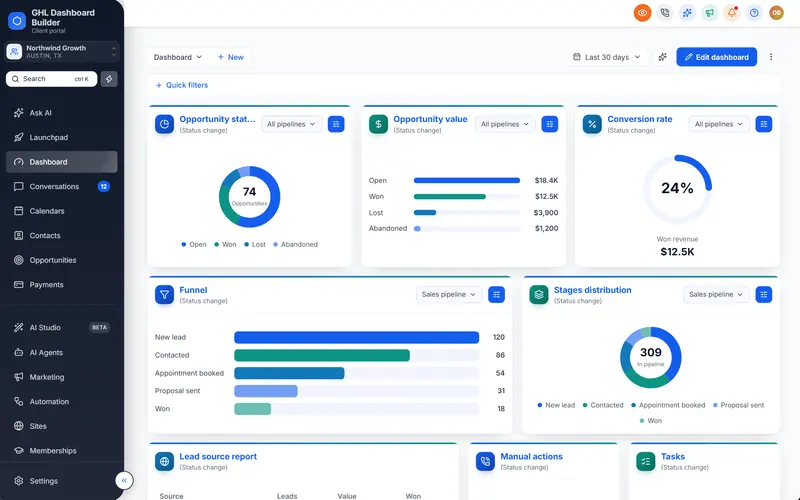
You set up a day spa with online booking, appointment reminders and review requests. Then the front desk logs in and sees a bright, busy interface that looks nothing like the studio’s calm sage walls and soft lighting, a menu that says Calendars when everyone in the building says bookings, and pipelines and launch tools nobody will ever open between the first facial and the last blow-dry. The system works. It just does not feel like the studio’s own, and a front desk that greets guests all day notices every extra click.
This guide shows how to set up GoHighLevel for med spas, salons and wellness studios so the account fits the way appointment businesses work, and looks like your agency’s own platform. HighLevel (also called GoHighLevel or GHL) has the building blocks a beauty or wellness business needs; the work is in choosing which ones to show, what to call them and how to present them. We cover what a studio actually uses, service calendars and deposits, menu wording, colors that stay readable in soft palettes, a step-by-step setup with HighLevel’s menu paths, the first screen the front desk sees, client privacy and HIPAA for med spas, and the limits of branding. GHL Dashboard Builder is an independent design service and is not affiliated with HighLevel; where our product helps, we say exactly what it does and what it does not.
What does a med spa or salon need from GoHighLevel?
A salon, spa or med spa needs HighLevel to fill the appointment book and keep it full: let clients book online at any hour, take deposits for long or high-value appointments, send reminders, answer messages quickly, rebook regulars and ask for reviews. Almost everything else is optional, and every unused menu item is something the front desk has to learn to ignore.
Think about who opens the account. In most studios the busiest user is the front desk or reception coordinator, the person who answers calls and messages, moves appointments and checks guests in. Stylists, therapists, aestheticians and injectors check their own day and their clients’ notes. A salon manager or spa director watches the week’s bookings, no-shows and staff utilization. The owner wants to know how many new clients came in and how many came back. In a med spa there is often a medical director or nurse injector too, who cares mostly that the clinical side stays in the clinical system.
Here is how the main HighLevel modules map to a studio’s daily work.
| HighLevel module | What a salon, spa or med spa uses it for | Typical user |
|---|---|---|
| Calendars | Service calendars for every treatment, staff schedules, rooms and stations | Front desk, providers |
| Conversations | Texts, calls, Instagram and Facebook messages, web chat and email in one inbox | Front desk |
| Contacts | Clients, with visit history, preferences and tags | Everyone |
| Payments | Deposits, card on file, invoices, products and gift offers | Front desk, manager |
| Automation (workflows) | Reminders, no-show follow-ups, rebooking nudges, birthday offers, review requests | Agency, manager |
| Memberships | Monthly facial or massage memberships, courses for clients | Manager |
| Reputation | Review requests after each visit | Owner, front desk |
| Marketing and Sites | Promotions, seasonal campaigns and booking pages | Agency |
| Opportunities | Consultations for high-ticket treatments, mostly in med spas | Med spa coordinator |
Two HighLevel features fit appointment businesses especially well. HighLevel’s service calendars give each treatment its own calendar with its own duration, staff and resources. HighLevel’s service menus group those calendars into categories such as Hair, Nails and Spa, so a client picks a service the way they would read a printed treatment menu.
What HighLevel is not, for most studios, is the point-of-sale and clinical system. Retail stock, commission splits and till reconciliation often live in salon software or a POS. In med spas, treatment charts, photos, consent forms and medical notes usually live in a dedicated med spa or EMR system. Agree that line with the owner on day one and design the dashboard for the jobs HighLevel will really do: bookings, messages, deposits, follow-up, memberships and reviews.
Why does a branded dashboard matter to spas and salons?
Beauty and wellness businesses sell an experience, and the look of everything they touch is part of it: the reception desk, the robes, the product shelves, the booking page and the confirmation text. A generic software screen on the front-desk monitor breaks that calm the moment a guest glances at it. A branded dashboard keeps your agency’s platform consistent with the studio’s look and makes the system feel made for them.
The audience is large and keeps changing staff, which is why many agencies build a beauty niche. The U.S. Bureau of Labor Statistics’ Occupational Outlook Handbook projects about 84,200 openings a year for barbers, hairstylists and cosmetologists, about 24,800 for manicurists and pedicurists and about 14,500 for skincare specialists, on average, over the 2024 to 2034 decade, at the time of writing. The same pages project employment growth of 5 percent for barbers, hairstylists and cosmetologists and 7 percent for skincare specialists over that decade.
Infographic
Beauty and wellness work in the USby the numbers
84,200
openings a year projected for barbers, hairstylists and cosmetologists, 2024 to 2034
(U.S. Bureau of Labor Statistics)
24,800
openings a year projected for manicurists and pedicurists
(U.S. Bureau of Labor Statistics)
14,500
openings a year projected for skincare specialists
(U.S. Bureau of Labor Statistics)
1
menu change in our Serene template: Calendars becomes Bookings
(GHL Dashboard Builder)
Sources: U.S. Bureau of Labor Statistics, Occupational Outlook Handbook (2024 to 2034 projections, at the time of writing); GHL Dashboard Builder Serene template.

For an agency, those openings matter in a practical way. Openings include people replacing workers who leave, so studios are hiring and training new front-desk staff and providers all the time. A system with the studio’s own words on the menu, and only the tools the studio uses, is quicker to teach to someone who started this week.
None of these numbers says a branded dashboard wins a salon more clients, and we will not claim it does. What a branded, simplified dashboard does is practical: the front desk finds things faster because the menu uses its words, the owner sees your agency’s platform rather than a resold tool, and new hires learn one system that looks like the studio’s own.
How does GHL Dashboard Builder set up GoHighLevel for a beauty or wellness business?
GHL Dashboard Builder is an independent design service that turns the standard HighLevel (GoHighLevel) dashboard into a branded platform: your colors, menu, login design, privacy mode and your clients’ language, installed with two lines of code. For beauty and wellness, the relevant pieces are the Serene template, the menu editor, the welcome banner and appointments board, notification pop-ups, privacy mode, single sub-account targeting and the login design.
The Serene template
Serene is our beauty and spa template, one of 27 templates, built for spas, salons and wellness studios. It sets sage, blush and sand on a quiet light sidebar, with a light, open heading font (Outfit), a soft body font (Lexend) at a light weight, generous line spacing and airy padding. Buttons are fully rounded pills, cards have large 28-pixel corners, and the header is a soft glass bar. Arabic, Urdu and Hebrew scripts each get a matching font if you switch the menu to a right-to-left language.
The menu comes with Calendars renamed to Bookings and marked with a small dot, so the front desk’s most-used page stands out. Opportunities, Launchpad, AI Studio and the App Marketplace are hidden, because a salon rarely tracks deals on a board. The Dashboard greets each user by name and shows stats, upcoming appointments, revenue and recent contacts in two columns. Its login design is a glass card over a warm spa photo with the line “Your bookings, guests and rituals, gently organized.” You can see it on the Serene template page and try it with your client’s logo and colors in the free builder. The preview uses a sample studio name and city; replace both with your client’s before you show it.
What each feature does for a studio’s team, and which plan includes it
| Feature | What it does for the studio’s team | Plan |
|---|---|---|
| Serene template | A sage, blush and sand design with Bookings already in the menu and unused tools hidden | Starter and up |
| Brand and colors | The studio’s own colors, fonts and logo across HighLevel | Starter and up |
| Welcome banner | A greeting with the user’s first name, date, clock and quick links to today’s bookings | Starter and up |
| Appointments board | The next appointments from every calendar in a card at the top of the Dashboard | Starter and up |
| Notification pop-ups | New messages, bookings and payments slide in with Reply, Mark read and Call, with quiet hours | Starter and up |
| Privacy mode | An eye button that blurs client names, emails, phone numbers, conversations and deal values | Starter and up |
| Single sub-account | The design shown only in the studios you choose, by link or Location ID | Starter and up |
| Menu editor | Your own wording for any of HighLevel’s 19 menu items, plus reorder, hide, favourites and live counts | Pro |
| Login page design | 25 login designs in the studio’s colors on your white-label sign-in page | Pro |
| Languages and right-to-left | The menu and navigation in 15 languages, with Arabic, Urdu and Hebrew right-to-left | Pro |
| A look designed by our team | A design built from scratch from a studio’s brand | Agency |
On the Starter plan you use the Serene template’s layout and menu as they come, including Bookings and the hidden items. Choosing your own wording, such as Appointments or Treatments, or showing Opportunities again for a med spa’s consultation pipeline, needs the Pro plan’s menu editor. The full list of what installs into HighLevel is on our features page.
How it installs and what the front desk sees
The builder produces the CSS and JavaScript for the design, and you install it with two short lines in HighLevel’s Custom Code boxes under Settings, Company, Whitelabel, Custom Code, which takes about five minutes. Change the design later, press Deploy to live, and HighLevel picks up the new version without re-pasting. On every plan we install it for you, as part of the one-time $100 setup fee.
After the install, the front desk logs in on your white-label domain and sees the studio’s colors, Bookings in the sidebar and a shorter menu without the tools nobody uses. The Dashboard greets each person by first name and lists the next appointments. HighLevel’s own white-label settings still handle the domain, logo and mobile app; our design restyles the web interface in the browser, and our guide to white-labeling HighLevel explains what those built-in settings cover.
On data: the builder never connects to your HighLevel account, and the installed code changes styling and menu labels only. It does not read or send your clients’ data anywhere.
How do service calendars and deposits work for salons and spas?
Use one service calendar per treatment, group them into a service menu, and attach the staff, rooms and equipment each treatment needs. Then decide which bookings need money up front: a deposit for long colour appointments, packages or injectables, and nothing for a quick fringe trim. This is the part of the setup that decides whether the studio trusts the system.
Services, groups and menus
HighLevel’s hair salon service calendar guide describes the pattern. Each service, such as a cut, a colour or a blow-dry, gets its own service calendar with its own duration and price. Services are placed in groups that act as categories, such as Hair Services, Nail Services and Spa Treatments, and each group gets its own booking link. Groups are required before calendars can appear in a service menu.
For a med spa, the same structure works with different categories: Consultations, Injectables, Laser, Facials and Body. Keep consultations as their own group, because they usually need a longer slot, a different form and sometimes a different provider from the treatment that follows.
Rooms, stations and equipment
A service calendar can be linked to rooms and equipment. In HighLevel’s terms, a room is the physical place a service happens, such as a chair, station or treatment room, and equipment is tracked by quantity: if the salon owns three blow dryers, at most three services that need one can run in the same slot. This is what stops two therapists booking the only couples’ room at 2 p.m., or a laser being booked twice.
When a service shows no available times, the salon guide’s troubleshooting order is a good habit: check the assigned staff, then the staff’s availability, then whether the room or equipment is already booked.
Deposits and card on file
HighLevel’s partial payment option collects a deposit at booking, as a fixed amount or a percentage of the service price, on several calendar types including service calendars and service menus. The rest goes on a draft invoice that the studio sends and collects after the appointment. HighLevel’s guide to collecting payments in calendars explains the other choice: charge up front, or save the card without charging so the studio can take payment later.
Two practical points to agree with the owner. First, at the time of writing, payment collection applies to bookings made through the calendar link; appointments the front desk enters by hand do not collect a deposit by themselves, so the front desk needs a habit, such as sending a payment link, for phone bookings. Second, write the cancellation and no-show policy into the booking page and the confirmation message in plain words, so a deposit never surprises a client.
Which bookings need what
| Service type | Typical slot | Deposit or card on file | Reminder pattern |
|---|---|---|---|
| Quick services: trims, brow shaping, short massages | 15 to 45 minutes | Usually none | One reminder the day before |
| Long colour, extensions, bridal hair | 2 to 4 hours | Deposit, fixed amount | Two days before and the morning of |
| Facials and spa packages | 60 to 120 minutes | Card on file or a small deposit | The day before, with arrival instructions |
| Med spa consultations | 30 to 60 minutes | Card on file | The day before, with intake form link |
| Injectables and laser | 30 to 90 minutes | Deposit or full prepayment for packages | Two reminders, plus aftercare message |
| Memberships | Recurring | Monthly charge through Memberships or Payments | Renewal and unused-credit reminders |
Treat the slot lengths as examples to adjust with the studio, not rules. The point of the table is the conversation: every service type gets an explicit decision about money and reminders before the booking pages go live.
Should Calendars be called Bookings? Wording the salon and spa menu
Use the words the front desk already says to guests: Bookings or Appointments rather than Calendars, and Clients or Guests rather than Contacts. Keep the rest of the menu where HighLevel users expect it and hide what the studio will never open. A day spa may prefer Guests, a hair salon Clients, a med spa Patients or Clients depending on how it presents itself.
HighLevel does not offer a setting to rename its main menu items. Agencies do it with custom JavaScript added at agency level, which our guide to HighLevel custom CSS explains, including why hand-written code needs care after platform updates. Our step-by-step guide to renaming GoHighLevel menu items covers the wording choices for other industries too.
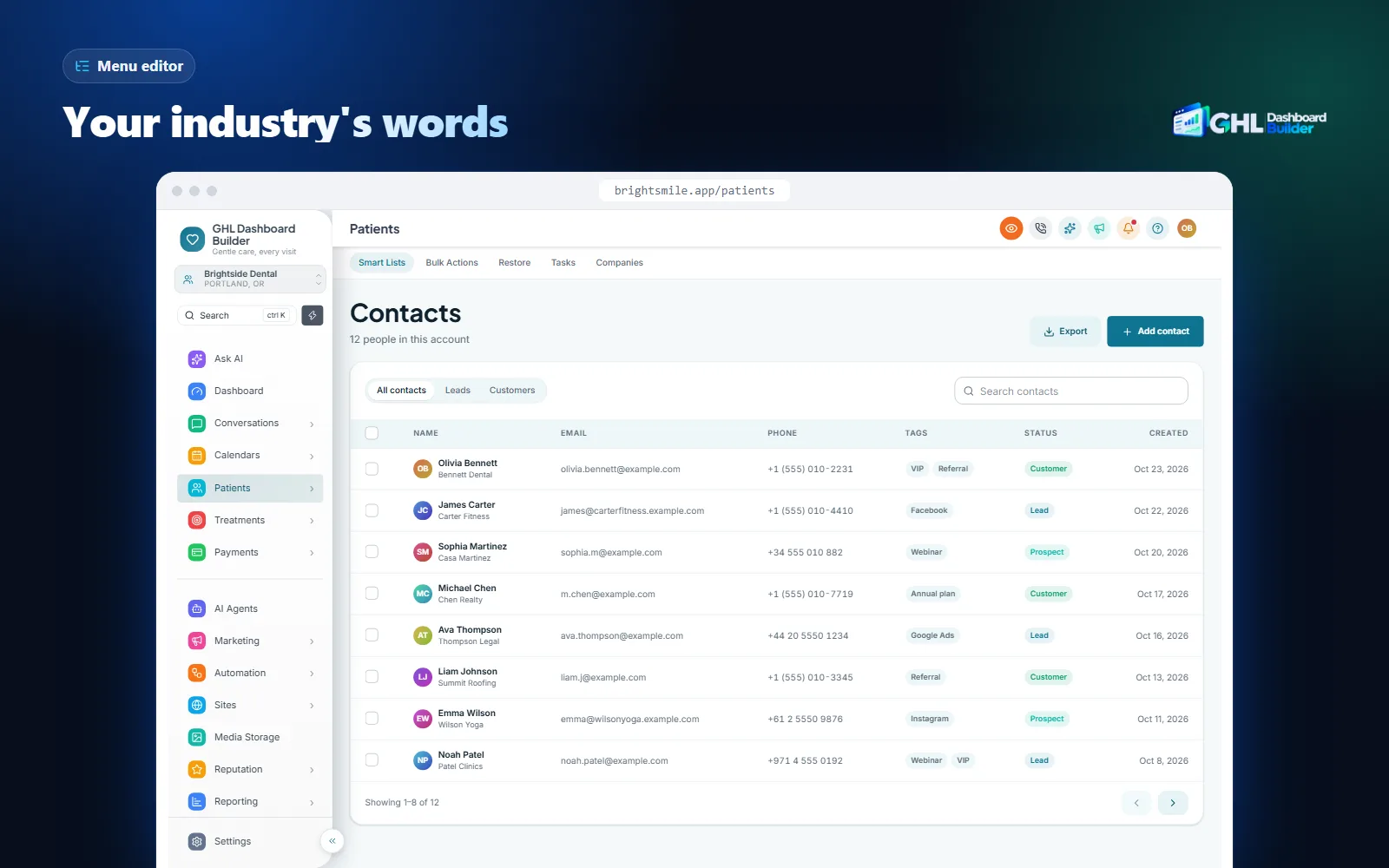
Here is a menu map that works for most beauty and wellness studios. Treat it as a starting point and change it with the person who runs the front desk.
| HighLevel calls it | Suggested label | Show or hide | Why |
|---|---|---|---|
| Calendars | Bookings or Appointments | Show | The page the front desk opens most; Serene uses Bookings |
| Contacts | Clients, Guests or Patients | Show | Match how the studio speaks to the people it serves |
| Conversations | Messages | Show | Texts, calls and social messages in one inbox |
| Payments | Payments or Sales | Show | Deposits, invoices and products |
| Memberships | Memberships | Show if sold | Monthly facial, massage or wellness plans |
| Reputation | Reviews | Show | Review requests after each visit |
| Opportunities | Consultations | Hide, or show for med spas | Serene hides it; med spas often track high-ticket consultations |
| Launchpad, AI Studio, App Marketplace | Hide | Agency territory, not the studio’s | |
| Sites and Marketing | Promotions | Show for the manager | Seasonal offers and booking pages |
The med spa consultation pipeline
Most salons never need a pipeline, which is why Serene hides Opportunities. Med spas are different: a client who asks about a laser package or a treatment plan worth several visits may need a consultation, a quote, a follow-up and a decision, and that journey fits a pipeline. A short one works: Enquiry, Consultation booked, Consultation done, Plan sent, Booked, Not now. Name stages after something that happened, and use the opportunity’s won and lost status rather than extra stages. Our guide to GoHighLevel pipeline customization goes deeper on stages and how the board looks once it is branded.
To show that pipeline in Serene, you turn Opportunities back on and, ideally, rename it Consultations. Both are menu editor changes, so a med spa that needs a pipeline is a Pro plan client on our side.
Which colors work for a spa or salon dashboard?
Beauty and wellness brands lean soft: sage, blush, sand, cream, dusty rose, champagne and sometimes black and gold. Soft palettes look beautiful on screen, but they are where contrast problems hide, because light colors next to light colors lose the difference that makes text readable. Test every pair of text and background colors before you promise a palette.
The W3C’s accessibility guidance sets a minimum contrast ratio of 4.5 to 1 for normal text and 3 to 1 for large text. In a studio this is practical: the front desk reads small appointment times on a monitor across a bright reception, and providers check their day on a tablet in a dim treatment room.
We measured eight color pairs from our own Serene template with the WCAG contrast formula. Body text, sidebar text and the dark text on blush are very readable. Two pairs land just under the line for normal text, and white on blush fails badly.
Source: Calculated with the WCAG 2.2 contrast formula from the Serene template's colors, November 2026. Minimum for normal text: 4.5 to 1; for large text: 3 to 1.
Three lessons follow. First, white on Serene’s sage scores 4.45 to 1, a hair under WCAG’s 4.5 to 1 minimum for normal text, and Serene’s button labels are 14-pixel medium text, which counts as normal size. If the studio needs every label to pass, darken the sage slightly: white on #4C6B58 scores 5.91 to 1 by the same formula and still reads as sage. Second, muted grey text passes on Serene’s white cards (4.72 to 1) but falls just short on the cream canvas (4.43 to 1), so keep muted labels on cards or darken the grey a step. Third, never put white text on blush: it scores 1.77 to 1. Blush works as a background for dark text, which is exactly how Serene uses it.
These checks matter more when you swap in the studio’s own colors. A salon’s signature dusty pink or champagne is often lighter than Serene’s sage, so test the exact hex code of every button color before you sign off on the design.
Design choices that work for beauty and wellness
- A light sidebar with a calm canvas. A sand or cream sidebar keeps the screen quiet; a soft active pill shows where you are without shouting.
- Light headings, readable body text. An airy heading font suits a spa brand; keep the body weight light but not thin, so client names and times stay legible.
- Generous spacing for the front desk, tighter lists for managers. Serene’s spacious density suits a reception screen; a busy salon with long client lists may prefer a slightly tighter setting.
- Rounded shapes. Pill buttons and large card corners echo the softness of the brand.
- One accent. Keep blush or rose for highlights and status, and one darker brand color for the main action, such as New booking.
Not every studio wants soft pastels. A barber shop may prefer something darker, a luxury salon black and gold, and a clinical med spa may prefer the look of our dental and medical template. Browse the template gallery and apply the same contrast rule to whichever one you start from. Our comparison of GoHighLevel dashboard themes explains how to choose a look and what free themes leave out.
How do you set up GoHighLevel for a med spa or salon, step by step?
Build the account first, then brand it, then test it with the people who will use it. Branding is easier to adjust once calendars, services and the menu are final, and testing with the front desk on a busy Saturday morning catches problems an admin at a quiet desk never sees. Menu paths below match HighLevel’s help center at the time of writing; HighLevel moves things occasionally.
Infographic
GoHighLevel for a spa or salonin six stages
- 1
Set the basics
Business hours, time zone, texting registration and the studio's numbers.
- 2
Build the service menu
One service calendar per treatment, grouped into categories.
- 3
Attach staff and rooms
Providers, chairs, rooms and equipment on every service.
- 4
Decide on deposits
Deposit, card on file or nothing, service by service.
- 5
Brand the dashboard
Serene or the studio's colors, Bookings in the menu, two-line install.
- 6
Test a real morning
Book, move and check in clients as the front desk.

Step 1: Build the account
- Create the studio’s sub-account from the agency view and set the time zone and business hours under the sub-account’s Settings, Business Profile. Business hours decide when bookings can be made and when automated replies say the studio is closed.
- Register for business texting before you send a single text. In the US, HighLevel’s A2P 10DLC brand and campaign registration is done under Settings, Phone System, Trust Center. Carriers make the final decision, so start early; reminders and rebooking texts are the heart of a studio setup.
- Turn on service menus if your account needs it. HighLevel’s service menu article describes switching the Service Menu option on in the calendar preferences and then creating menus under Calendars, Calendar Settings, Service Menu.
- Add the studio’s staff as users, then set each provider’s working hours and days off. Providers who only see their own bookings need fewer permissions than the front desk.
- Create rooms and equipment in the calendar settings: chairs, stations, treatment rooms, the laser or any device that only one client can use at a time.
- Create one service calendar per treatment, with its duration, price, buffer time and assigned staff, and link each one to its room and equipment. HighLevel’s guide to creating service calendars shows the fields.
- Group the services into categories and build the service menu clients will book from. Check that each category reads like the studio’s printed treatment menu.
- Set deposits or card on file for the services the owner chose, and write the cancellation policy into the booking page and confirmation message.
- Build the core workflows under Automation: booking confirmation, reminders, a no-show follow-up, a rebooking nudge a few weeks after a visit, a birthday message and a review request after the appointment.
- Connect the studio’s Google Business Profile under Reputation, Settings so review requests go to the right listing.
Step 2: Brand the dashboard
- Complete the identity layer at agency level under Settings, Company: logo, white-label domain and legal links.
- Choose or design the theme: Serene or the studio’s own colors, menu wording, hidden items, welcome banner and appointments board.
- In the agency view, open Settings, Company, Whitelabel and scroll to Custom Code.
- Copy whatever is already in the Custom CSS and Custom JavaScript boxes into a text file as your rollback.
- Paste the new CSS and JavaScript and save. HighLevel shows a warning about third-party scripts; read it and confirm only if you trust the code.
- Open the studio’s sub-account in a new tab and refresh.
Step 3: Test with real users
- Log in as a front-desk user, not as an admin, and walk through a normal morning: a client texts to move an appointment, the front desk finds a free slot, moves it and replies.
- Book a long colour or a med spa consultation through the public link and check the deposit is taken and the room is blocked.
- Log in as a provider on a tablet and check that today’s bookings are easy to read.
- Check every pill button, badge and tag for readable text, especially anything in blush, rose or champagne.
- Ask the front desk to find three things without help, and note where they hesitate.
That is 21 steps across three stages. The first stage takes the longest and holds the studio’s real value; the branding stage is short because the design is chosen before you start.
What should the front desk see first each day?
The front desk should open HighLevel to today’s book: who is arriving next, who is waiting for a reply and which bookings still need a deposit. In a studio, the first ten minutes before the doors open set the day, and a Dashboard full of charts nobody reads wastes them. Put the appointments and the inbox first.
HighLevel’s own Dashboard is built from widgets the agency chooses, and it is useful for owners who want revenue and lead figures. The front desk’s question at 8:45 a.m. is simpler: what is happening today? Four of our features answer that question on the first screen.
- Welcome banner. A greeting with the user’s first name, the date, a clock and quick links to the pages the front desk opens first, such as Bookings and Messages. There are 12 designs and nine layouts, or you can put the studio’s own photo or colors behind it.
- Appointments board. The next appointments from every calendar in one card at the top of the Dashboard, each a click away from the calendar. The front desk sees the morning’s guests and providers without opening Bookings.
- Live counts. Real numbers from HighLevel on the menu and in the welcome banner: unread conversations, appointments today, tasks due, new opportunities and overdue invoices. The overdue-invoices count reminds the front desk to collect balances left on draft invoices after deposits.
- Notification pop-ups. New messages, bookings and payments slide in with a “Hey {name}” greeting and Reply, Mark read and Call buttons, with quiet hours and an optional chime. A client who texts to say they are running late gets an answer while the front desk can still shuffle the next slot.
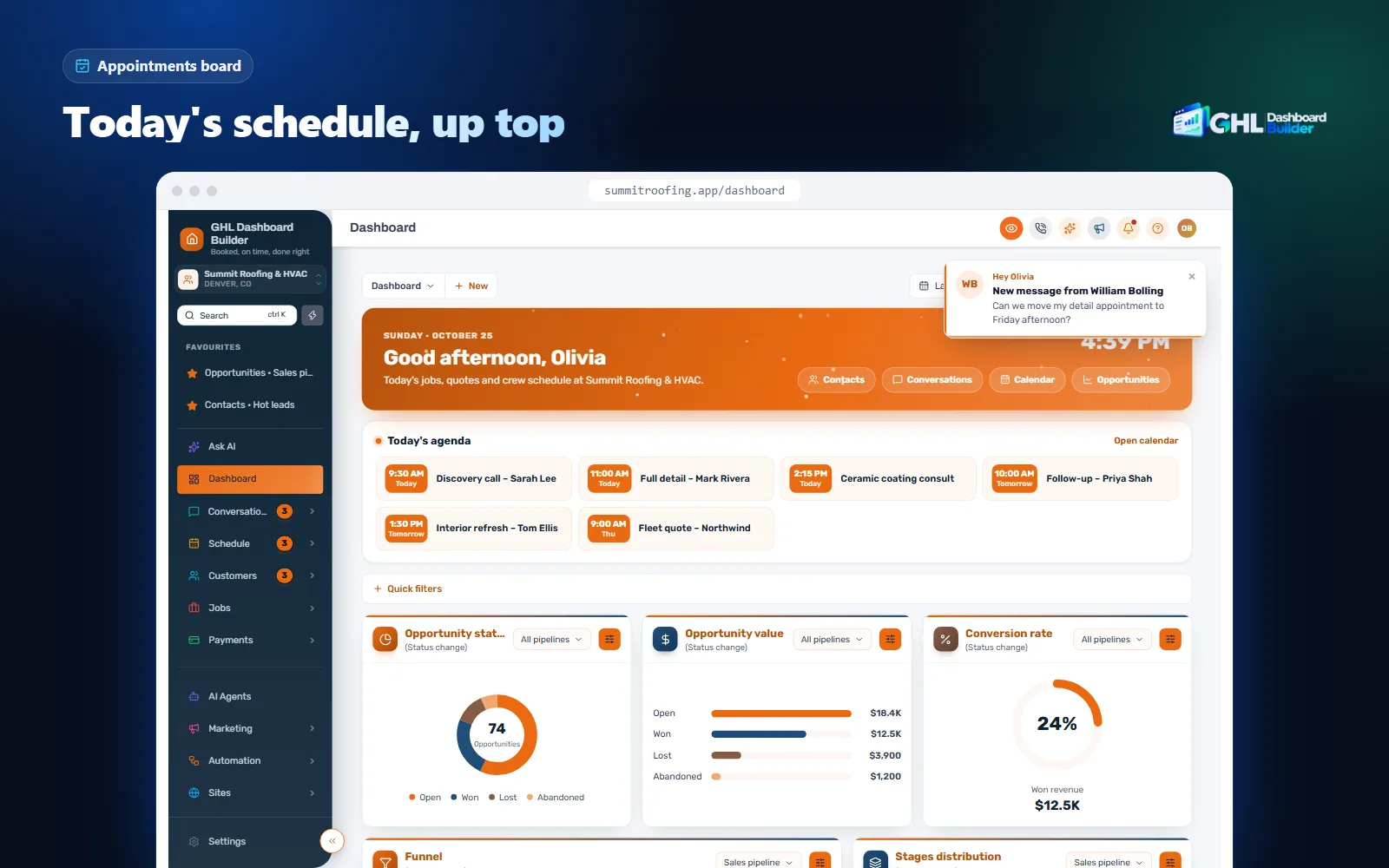
There is also a favourites star in the header, which pins any page to the top of the menu. A salon manager can pin the week view of Bookings and a med spa coordinator the consultation pipeline, so each reaches their own page in one click. Our guide to branded welcome banners and dashboard widgets shows the banner designs, and our guide to GoHighLevel dashboard notifications covers the pop-ups and quiet hours.
These features show HighLevel’s own data in a different place; they do not add a till, a stock list or a provider commission report. If the studio runs a POS or salon system for that, keep it, and let HighLevel’s Dashboard be the front desk’s view of bookings, messages and payments.
How do you keep client details private, and what about HIPAA for med spas?
Use sample data for every demo and training video, blur real data whenever you must show a live studio’s account, and for med spas, decide before launch whether health information will be stored in HighLevel at all. Beauty and wellness clients share personal details: phone numbers, birthdays, skin concerns, treatment history and sometimes before-and-after photos.
Screen sharing happens more often than agencies expect. There are sales calls with new studios, monthly reviews with the owner, training sessions for new front-desk staff and the reception monitor itself, which guests can see from the waiting area. A conversation list on that monitor can show a client’s message about a treatment they would rather keep private.
A practical routine for any agency serving beauty and wellness businesses:
- Build a demo sub-account. Fill it with clearly fake clients, bookings and conversations. Use it for every sales call and every training video.
- Never record in a live studio’s account unless client data is hidden first.
- Angle or blur the reception screen. If guests can see the monitor, keep the conversation panel closed when the desk is busy.
- Share one browser tab, not your whole screen, so notifications and other clients’ accounts stay private.
- Keep sensitive notes out of fields shown on lists, such as treatment details or medical history; in a med spa, keep them in the clinical system.
- Write the routine down and give it to every front-desk user and provider you train.
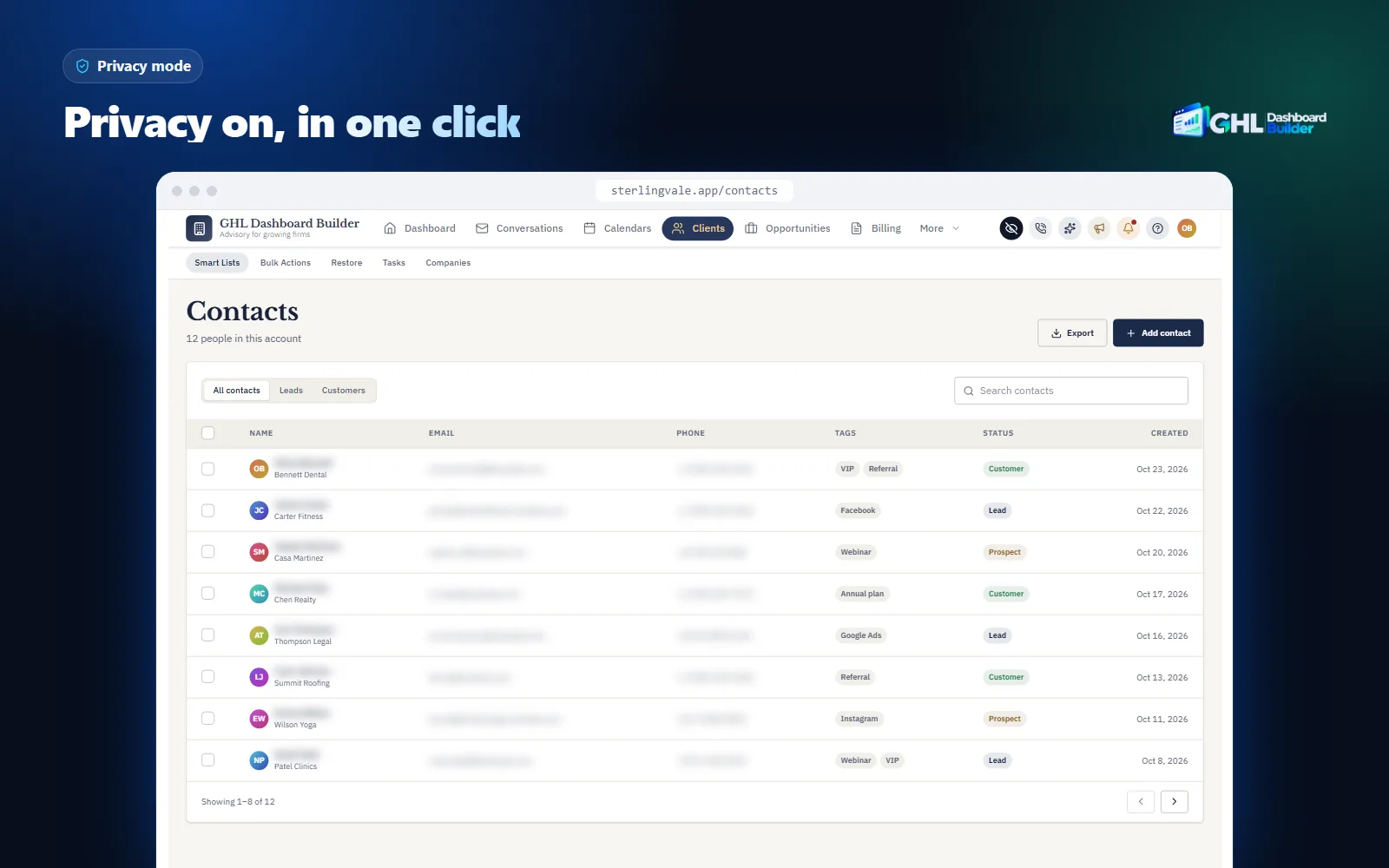
Our guide to hiding client data in GoHighLevel covers screen-sharing habits in more depth.
HIPAA and med spas
Many med spas perform medical treatments under a medical director, and if a practice stores protected health information in HighLevel, HighLevel’s own HIPAA setup matters. HighLevel’s HIPAA help article describes the process: the agency activates HighLevel’s HIPAA offering and signs a Business Associate Agreement (BAA), a contract in which a vendor agrees to protect health information, then turns HIPAA on for each sub-account under Sub-Accounts, the location, Advanced Settings. The article notes that once enabled, the setting cannot be turned off.
Whether a particular med spa needs this is a question for the practice and its compliance adviser, not for a dashboard designer, and we do not give legal advice. What we can say clearly is what a design does and does not change. GHL Dashboard Builder changes how HighLevel looks and what its menu says. It does not change how HighLevel stores, encrypts or shares data, and installing a theme neither makes an account HIPAA compliant nor affects HighLevel’s HIPAA settings. Our setup guide for dental and medical practices covers patient-facing clinics in more depth.
Privacy mode is a visual safeguard on your own screen. It does not encrypt anything, change who can access records or replace the routine above; it makes the routine easier to follow when you are moving quickly between clients.
What about bilingual studios and agencies with mixed industries?
Translate the menu for the people who use it every day, and brand only the sub-accounts that need a different look. Many studios have front-desk staff or providers who work more comfortably in another language, and many agencies serve salons alongside contractors, clinics and real estate teams that should keep their own look.
A menu in the team’s language
The menu and navigation can be shown in any of 15 languages on the Pro and Agency plans, with your own wording for any label, so Bookings can read Reservas in Spanish or Rendez-vous in French. Our languages page lists all 15, and our Spanish menu language page shows HighLevel’s menu items in Spanish. Serene supports right-to-left layout, with matching fonts, for Arabic-, Urdu- and Hebrew-speaking studios.
Two limits to explain to the studio up front:
- The menu and navigation can be translated by a theme; HighLevel’s own pages follow HighLevel’s language settings. That includes HighLevel’s builders, booking widgets, system emails and the mobile app. Check the screens the front desk uses most, such as conversations and calendars, before promising a fully translated system.
- Client-facing messages are separate. Confirmations, reminders and review requests are written in the workflow builder, in whatever language the studio chooses. Write them with the owner, in the studio’s voice.
One studio, or a few, with their own look
Agency-level custom code in HighLevel applies across the interface your users see, including sub-account views. To give one studio its own look, the theme has to check which sub-account is open, using its Location ID, and apply the design only there. Situations where that makes sense:
- A pilot. You test the Serene design on one salon before offering it to every beauty client.
- A premium client. A larger med spa pays for a fully branded platform in its own colors.
- A mixed agency. Your salons and spas get Bookings and a sage theme; your contractors keep the wording from our guide for home-services companies, and gyms keep the members-first setup from our guide for gyms and fitness studios.
- A studio with several locations. Each branch is a sub-account, and all of them should share the brand’s look.
Be exact with clients about one thing: from one install, one design is shown in the sub-accounts you choose. Our single sub-account page explains how to add them by link or Location ID, and our guide to GoHighLevel sub-account branding walks through testing the result. If several studios each want a different look, talk to us about how to set that up.
What can go wrong, and what doesn’t branding solve?
Most problems come from treating branding as more than it is, or from skipping the test with the front desk on a busy day. A theme is custom code running in the browser. HighLevel provides the place for it but does not officially support it, so a HighLevel update can occasionally leave part of a screen unstyled until the theme is refreshed.
| Problem | Why it happens | What to do |
|---|---|---|
| A service shows no available times | Staff, availability, room or equipment is missing or already booked | Check staff, then availability, then rooms and equipment |
| Phone bookings have no deposit | Calendar payments apply to bookings through the booking link | Send a payment link for phone bookings, or book them through the link |
| Clients are surprised by a deposit | The policy is not on the booking page | Write it on the booking page and in the confirmation |
| White button text is hard to read | White on light sage or pink falls below 4.5 to 1 | Darken the button color, such as #4C6B58, or use dark text |
| A med spa needs a pipeline but Serene hides it | Serene hides Opportunities for salons | Show it again and rename it Consultations with the menu editor |
| Reminder texts are blocked | Business texting is not registered | Complete A2P 10DLC registration before launch |
| Part of a screen loses its styling after an update | HighLevel changed that screen’s structure | Update the theme; keep a rollback copy of the old code |
| Your support team cannot find Calendars | The studio’s menu says Bookings | Keep a one-page map of renamed items for your team |
What branding will never do
- It will not change HighLevel’s features, data, permissions, HIPAA settings or billing.
- It will not change the HighLevel mobile app, the emails HighLevel sends, or client-facing booking widgets, forms and pages; those follow HighLevel’s own settings and builders.
- It will not add a POS, retail stock, commission reports, treatment charts or consent forms. Those need the right software or an integration.
Being clear about these limits in the sales conversation protects you. An owner who knows exactly what they are buying is less likely to be disappointed later.
DIY code, a developer or a ready-made design: which suits a beauty agency?
All three can produce a branded dashboard for a salon or spa. The difference is how much time each takes and who keeps it working after HighLevel updates. For an agency with one or two studio clients, cost and speed usually decide; for an agency building a beauty and wellness niche, maintenance matters most.
| Route | Good for | Watch out for |
|---|---|---|
| Write your own CSS and JavaScript | Agencies with a developer and time to maintain code | Finding selectors, testing every screen, fixing breaks after updates |
| Hire a freelance developer | A one-off custom look | Who fixes it after the next HighLevel update, and at what cost |
| Start from a ready-made design such as Serene | Fast, consistent results across many studios | Templates cover common needs; a unique look needs more design work |
If you write your own, start with the safe approach in our custom CSS guide. If you would rather start from a finished design, GHL Dashboard Builder’s plans are one-time payments with no monthly fee: Starter at US$280 for one design from a template such as Serene, Pro at US$480 for up to 3 designs with your own menu wording, a branded login page and 15 languages, and Agency at US$880 for up to 100 designs, a look designed by our team, custom code and lifetime updates, each plus a one-time US$100 setup fee for which we install it in your HighLevel. Starter and Pro include 12 months of updates, then optional at US$99 a year. Full details are on the pricing page.
What to do next
- Agree the line with the owner. Write down which jobs HighLevel will do (bookings, messages, deposits, reminders, memberships, reviews) and which stay in the POS, salon software or clinical system.
- List every service with its duration, staff, room and deposit rule before you build a single calendar, and settle the cancellation policy in writing.
- For med spas, decide on HIPAA first. If health information will live in HighLevel, have the practice confirm its needs with its adviser and complete HighLevel’s BAA and HIPAA setup before launch.
- Try the Serene look on HighLevel’s screens in the free builder with the studio’s colors and logo, and check the contrast of every pastel button.
- Roll out to one studio first, test a busy Saturday with the front desk, and review wording and hidden items after 30 days.
If you would rather have the design done for you, or your beauty clients need something no template covers, get in touch and tell us about the studios you serve.